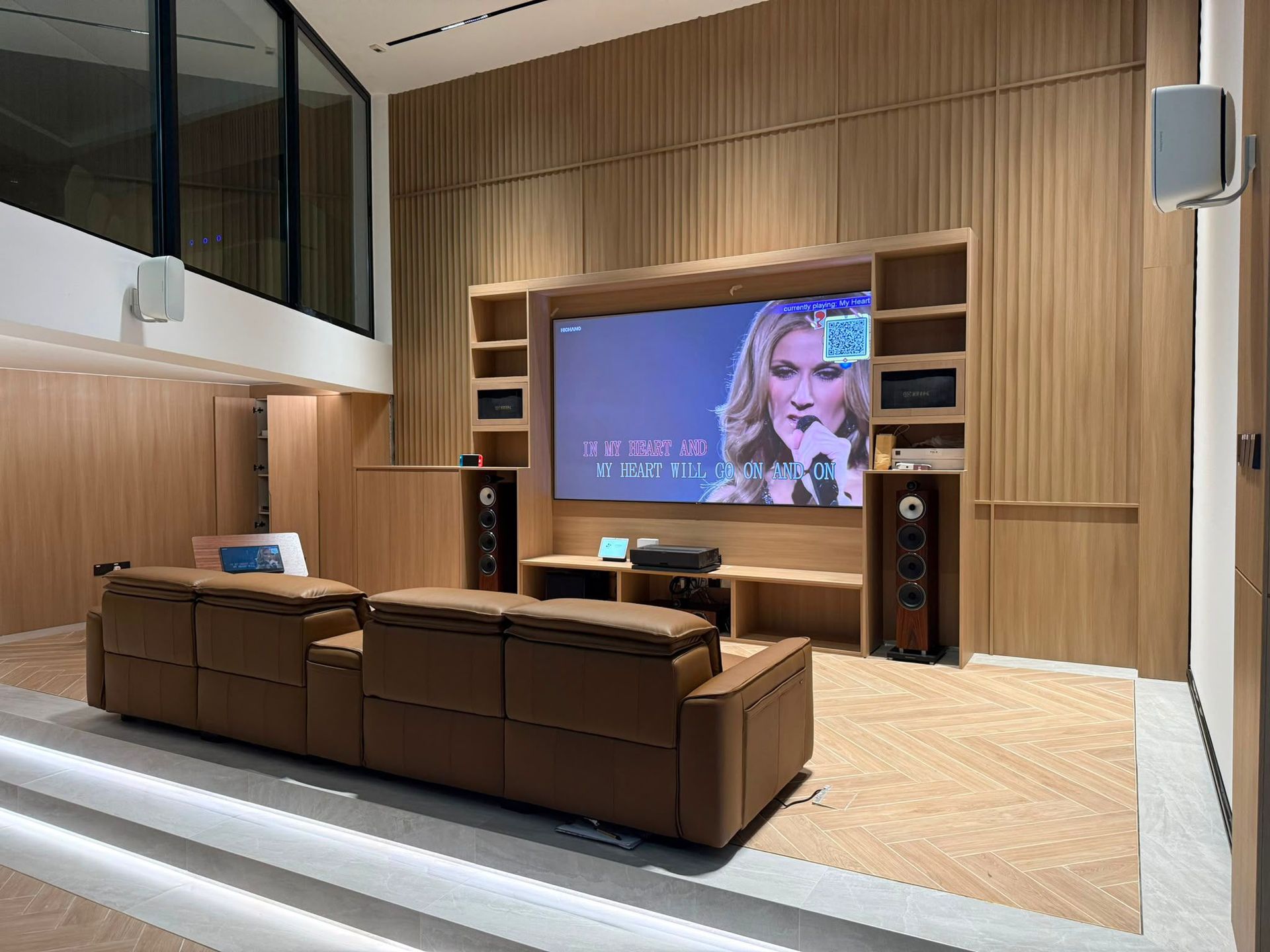
Epson Projector Singapore.
Invisible Architecture. Cinematic Scale.
We engineer custom Epson laser projection systems for living rooms, media spaces, and dedicated cinemas in Singapore. From ultra-short throw (UST) solutions to architectural long-throw integration, we coordinate screens, lighting, and smart-home control.
The Epson Light Engine: Core Technologies.
3LCD Colour Performance
Epson’s 3LCD architecture processes white and colour light simultaneously. This design eliminates the "rainbow effect" sometimes visible in single-chip systems. By maintaining equal White and Colour Light Output (CLO), HDR content retains strong colour volume even in brighter scenes.
Long-Life Laser Light Source
Powered by a laser diode array, Epson’s home cinema line delivers cinematic brightness without conventional lamp warm-up times. Expect consistent performance with up to 20,000 hours of laser light-source life where officially supported. The dynamic contrast engine modulates the laser output to achieve deep black levels during darker scenes.
Optical Engine Configuration
Explore three Epson projection approaches by room type to understand scale, required geometry, and optical solutions.

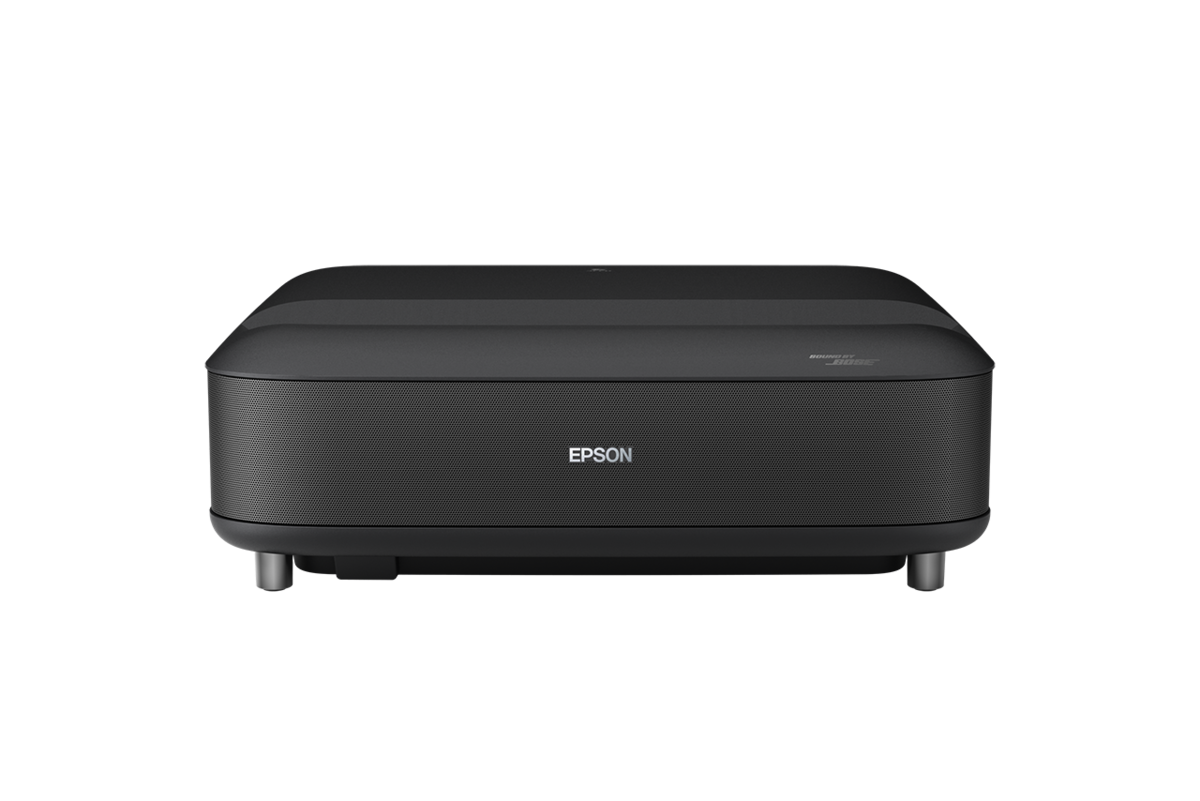
3,600 Lumens Colour & White
Up to 20,000 Hours Life
Sound by Bose
Epson EH-LS670B
An Ultra Short Throw (UST) projector for living room entertainment. Positioned directly below the screen to minimize cable routing across the room. Includes Google TV and audio by Bose.
Explore Model →The Optical Engine Matrix
EH-LS670B
Living Room UST
- Tech: 4K PRO-UHD
- Display: Up to 120 Inches
- Audio: Sound by Bose
- Smart: Google TV Built-in
EH-LS970B
Premium Media Space
- Tech: 4K PRO-UHD
- Display: Up to 150 Inches
- Contrast: > 5,000,000:1 Dynamic
- Processing: AI-Powered Image Processing
EH-LS12000B
Custom Cinema
- Tech: 4K Enhancement
- Display: Scalable Large Format
- Contrast: 2,500,000:1 Dynamic Black
- Lens Shift: Motorised Vertical/Horizontal
- Processing: Epson ZX Picture Processor
Which Epson Projector Should You Choose?
Understanding the official Epson lineup helps match the right light engine to your room's requirements.
Ultra Short Throw
Epson EH-LS670B
Typical fit: Living-room UST installations.
Offers simpler living-room integration with built-in Google TV and Bose audio. Best suited when you want an all-in-one upgrade up to the official supported screen size without immediate full-surround installation.
Explore Model →Epson EH-LS970B
Typical fit: Larger or brighter UST media spaces.
A higher-output UST with more advanced processing. Consider this when managing daytime ambient light or supporting a larger image size in a media room.
Explore Model →Cinema & Custom Installation
Epson EH-LS9000B
Typical fit: Home-cinema long throw.
Engineered for dedicated cinema or media-room positioning. Features 4K resolution via pixel shift, HDR10+ support, and motorised lens features where officially supported.
Explore Model →Epson EH-LS12000B
Typical fit: High-performance dedicated cinema.
Features 4K enhancement, strong lens flexibility, and 4K/120Hz input capabilities. Best suited when high-performance cinema viewing and gaming are priorities.
Explore Model →Epson EH-QL3000W
Typical fit: Large-scale architectural projection.
A premium architectural projector offering 6,000 lumens of colour and white output. It utilises an interchangeable lens ecosystem, making it appropriate for larger or more demanding projection environments. Final lens selection depends on room geometry, screen size, and required throw distance.
Precision Processing: High Frame Rate Performance.
4K/120Hz Input for Gaming
The Epson EH-LS12000B supports 4K/120Hz input for compatible gaming consoles and PCs, enabling smoother motion rendering and reduced input lag during fast-paced gameplay.
Integrated Audio Options
For living room enthusiasts, our Ultra-Short Throw units (EH-LS670B and EH-LS970B) feature built-in acoustic arrays, delivering robust sound directly from the unit for streamlined spaces that may not immediately require external routing.
A Simple Guide to Choosing Your Home Theatre Display
The right choice depends on three factors: your target image size, the amount of ambient light in the room, and how important dedicated surround-sound performance is to you.
Large-Format Televisions
If your target image size is around 85–100 inches and daytime viewing is a priority, a large television is often the simpler solution. Televisions emit light directly toward the viewer, generally maintaining stronger perceived contrast and black levels in bright environments, particularly when curtains or windows are frequently open.
Laser Projection
Projection becomes increasingly attractive when you want an image size beyond roughly 120 inches and the cinematic visual scale that comes with it. Because projectors reflect light from the screen rather than emitting it directly, many viewers prefer this softer visual character for extended movie sessions in controlled lighting environments.
The Cinematic Scale Advantage
If your room allows approximately 2.8m or more of usable screen width, very large projection becomes possible (depending on aspect ratio, throw distance, and projector output). This massive visual scale transforms entertainment, media, and karaoke rooms by creating a much stronger shared viewing experience.
UST or Long Throw? Choosing the Right Architecture
Ultra Short Throw (UST)
UST projectors sit discreetly on cabinetry very close to the screen wall, casting the image upwards. This often concentrates the projector and source equipment around the front cabinet, making power access easier and removing the need for long ceiling HDMI runs.
- Best suited when: You want minimal ceiling renovation, the existing TV console can be used, and living-room integration matters.
- Considerations: Careful attention must be paid to cabinet height, screen flatness, and ambient light management.
Long Throw Projection
Long-throw engines require greater throw distance and can often be ceiling-mounted behind the main seating area or toward the rear of the room. This keeps the front wall focused entirely on the screen and speakers, offering greater flexibility for furniture placement.
- Best suited when: Larger screen sizes are desired, dedicated cinema planning is possible, and surround-sound quality is a priority. Final screen size depends on projector output, lens/throw geometry, room lighting, and screen design.
- Considerations: Requires advance planning for structural mounting, ceiling-level power, and HDMI signal infrastructure.
The Canvas: Redefining the Screen
An Epson laser engine performs best when paired with the correct optical surface. The projection surface influences contrast depth, ambient light control, and acoustic placement.
Ambient Light Rejecting (ALR)
ALR screens are engineered to reject or redirect off-axis ambient light while reflecting projector light toward the viewing area. They are often paired with UST projectors in brighter rooms to help manage perceived contrast.
Acoustically Transparent (AT)
With a very large conventional screen, the image occupies the ideal physical location for the front speakers. An acoustically transparent screen allows the front left, centre, and right (LCR) speakers to be positioned behind the image rather than being forced below or beside it. This helps dialogue and effects originate closer to the action on screen.
Audio Integration: Matching Sound to Scale
A large visual canvas demands proportionate sound. Integrating your speakers correctly with the projection screen is critical for a convincing cinematic experience.
The Centre Speaker Challenge
With a large television or a non-acoustically-transparent projection screen, the centre speaker often has to sit below the display. This can place dialogue below the visual action. However, good speaker selection, aiming, and room calibration can help maintain convincing dialogue localisation even when the speaker must sit below the screen.
UST Built-In Audio vs. Surround
Epson models like the EH-LS670B and EH-LS970B include integrated audio by Bose according to official specifications. For casual living-room use, this built-in audio can be convenient. However, for a dedicated cinema experience, external LCR, subwoofer, and surround/Atmos speakers remain the more scalable route.
Custom Front Audio Integration for UST
Many common UST/ALR screen installations are not acoustically transparent. While specialist UST-compatible acoustically transparent solutions exist, the projector, screen material, cabinet geometry, and speaker placement must be matched carefully. For living-room systems, HAP can design around a centre speaker, custom-width passive soundbar, or architectural speakers depending on your cabinet height and room aesthetic.
Need a UST screen and front-speaker layout planned together? Speak to HAP →Projection Planning & AV Integration
We collaborate directly with your architect and interior designer to ensure your AV ecosystem is integrated seamlessly into the room.
-
Room & Image Planning
We evaluate specific throw distances, screen sizes, viewing distances, and optimal projector positioning based on your floor plan and ceiling height.
-
Infrastructure Coordination
Working with your contractors, we coordinate mounting requirements, dedicated power, HDMI signal paths, rack locations, and service access before wall and ceiling finishes are closed. Where practical, HAP can plan spare conduit or additional signal infrastructure during renovation so future cable replacement does not require reopening completed ceilings.
-
Image Setup
We align the projector geometry to the screen and adjust picture settings to complement the ambient light characteristics of the room.
-
Smart-Home Integration
We integrate the projector and AV system into Control4, with Lutron lighting and shading coordinated into the same cinema scenes where applicable, simplifying operation to a single button press.
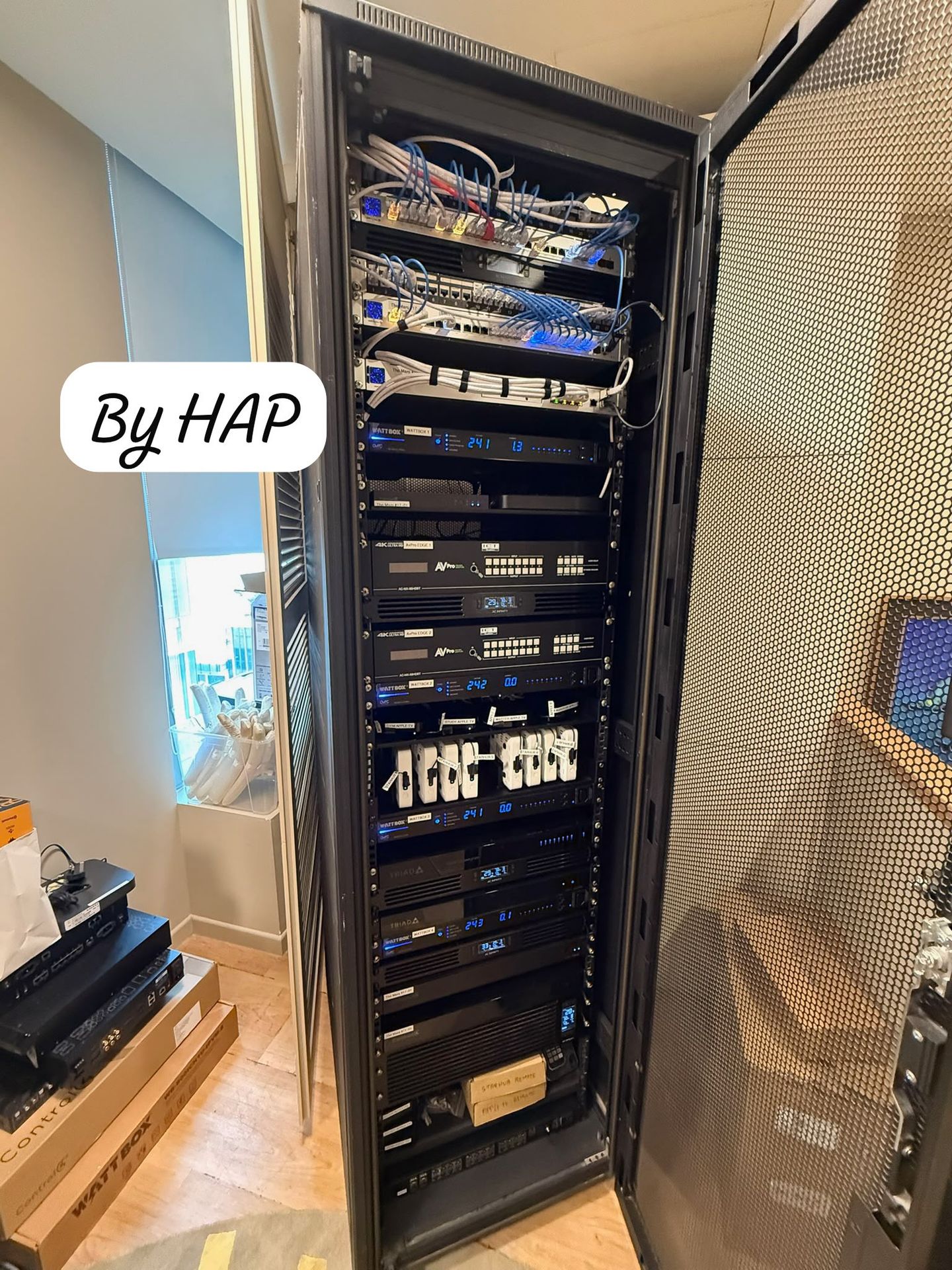
The HAP Ecosystem: Beyond the Projector
A clear image requires a controlled environment. HAP integrates the Epson optical engine into a wider smart-home architecture.
Architectural Audio
A large visual canvas demands proportionate sound. We pair Epson projection systems with integrated acoustic solutions—including Bowers & Wilkins architectural speakers—designed to complement the room without dominating the visual aesthetic.
Lighting & Smart-Home Control
Contrast depends on lighting control. Through integration with Control4 and Lutron systems, selecting a cinema mode can automatically dim connected lighting, lower shades, and power on the projection system.
Centralised AV & Networking
Keep living and entertaining zones clear of equipment. We relocate AV receivers, media players, and network switches out of the living room and into a dedicated AV rack, using robust infrastructure to deliver high-quality video to your Epson display.
Epson Projectors Singapore: Buyer's Guide & FAQs
If your target image is around 85–100 inches and the room is used heavily in daylight, a large television is often the simpler choice. If you want 120 inches or more and can control the room lighting, projection becomes increasingly attractive.
UST is generally easier to integrate into an existing living room, while long throw offers greater flexibility for large dedicated cinemas and acoustically transparent screen systems. Both can deliver excellent results when paired with the right screen and ambient light control.
Yes, if you use an Acoustically Transparent (AT) screen. It allows the front speakers to sit behind the image, helping dialogue and effects originate closer to the action on screen. This is very common in long-throw dedicated cinemas, though specialist UST-compatible AT screens also exist.
When evaluating home cinema projectors in Singapore for bright living rooms, Ultra Short Throw (UST) models like the Epson EH-LS670B and EH-LS970B are popular choices. They sit close to the wall, can project up to 120-150 inches, and are often paired with compatible Ambient Light Rejecting (ALR) screens to help manage perceived contrast.
It depends on the specific model and desired screen size. UST models sit mere centimetres from the wall. Standard throw models like the EH-LS12000B require specific throw distance calculations based on their lens capabilities. HAP calculates exact throw distances and optical geometries during the planning phase.
Yes. UST projectors like the EH-LS670B are well-suited for living rooms without false ceilings. For landed properties or dedicated rooms, long-throw units can be integrated into the ceiling or bulkheads.
Project costs vary based on requirements. They depend on screen material (ALR vs Acoustically Transparent), AV receiver selection, smart-home integration, and the specific Epson projector chosen. We provide accurate quotes after an initial consultation.
Epson’s laser engines provide up to 20,000 hours of laser light-source life where officially supported, reducing the need for traditional bulb replacements under normal usage.
No. By pairing higher-lumen Epson UST models with Ambient Light Rejecting (ALR) screens, you can maintain reasonable contrast in living spaces. However, managing direct sunlight and ambient light remains important for the best picture quality.
Yes. We integrate the projector and AV system into Control4, with Lutron lighting and shading coordinated into the same cinema scenes where applicable. A single command can adjust the lighting, manage motorised blinds, turn on the Epson projector, and switch the AV receiver to the correct audio source.
Experience Epson Projection at HAP Singapore
Now that you understand the options, let us design the exact system for your room. Test ALR screens, compare UST with long-throw projection, and experience integrated smart home control in person.
Epson Projector Singapore.
Invisible Architecture. Cinematic Scale.
We engineer custom Epson laser projection systems for living rooms, media spaces, and dedicated cinemas in Singapore. From ultra-short throw (UST) solutions to architectural long-throw integration, we coordinate screens, lighting, and smart-home control.
The Epson Light Engine: Core Technologies.
3LCD Colour Performance
Epson’s 3LCD architecture processes white and colour light simultaneously. This design eliminates the "rainbow effect" sometimes visible in single-chip systems. By maintaining equal White and Colour Light Output (CLO), HDR content retains strong colour volume even in brighter scenes.
Long-Life Laser Light Source
Powered by a laser diode array, Epson’s home cinema line delivers cinematic brightness without conventional lamp warm-up times. Expect consistent performance with up to 20,000 hours of laser light-source life where officially supported. The dynamic contrast engine modulates the laser output to achieve deep black levels during darker scenes.
Optical Engine Configuration
Explore three Epson projection approaches by room type to understand scale, required geometry, and optical solutions.
3,600 Lumens Colour & White
Up to 20,000 Hours Life
Sound by Bose
Epson EH-LS670B
An Ultra Short Throw (UST) projector for living room entertainment. Positioned directly below the screen to minimize cable routing across the room. Includes Google TV and audio by Bose.
Explore Model →The Optical Engine Matrix
EH-LS670B
Living Room UST
- Tech: 4K PRO-UHD
- Display: Up to 120 Inches
- Audio: Sound by Bose
- Smart: Google TV Built-in
EH-LS970B
Premium Media Space
- Tech: 4K PRO-UHD
- Display: Up to 150 Inches
- Contrast: > 5,000,000:1 Dynamic
- Processing: AI-Powered Image Processing
EH-LS12000B
Custom Cinema
- Tech: 4K Enhancement
- Display: Scalable Large Format
- Contrast: 2,500,000:1 Dynamic Black
- Lens Shift: Motorised Vertical/Horizontal
- Processing: Epson ZX Picture Processor
Which Epson Projector Should You Choose?
Understanding the official Epson lineup helps match the right light engine to your room's requirements.
Ultra Short Throw
Epson EH-LS670B
Typical fit: Living-room UST installations.
Offers simpler living-room integration with built-in Google TV and Bose audio. Best suited when you want an all-in-one upgrade up to the official supported screen size without immediate full-surround installation.
Explore Model →Epson EH-LS970B
Typical fit: Larger or brighter UST media spaces.
A higher-output UST with more advanced processing. Consider this when managing daytime ambient light or supporting a larger image size in a media room.
Explore Model →Cinema & Custom Installation
Epson EH-LS9000B
Typical fit: Home-cinema long throw.
Engineered for dedicated cinema or media-room positioning. Features 4K resolution via pixel shift, HDR10+ support, and motorised lens features where officially supported.
Explore Model →Epson EH-LS12000B
Typical fit: High-performance dedicated cinema.
Features 4K enhancement, strong lens flexibility, and 4K/120Hz input capabilities. Best suited when high-performance cinema viewing and gaming are priorities.
Explore Model →Epson EH-QL3000W
Typical fit: Large-scale architectural projection.
A premium architectural projector offering 6,000 lumens of colour and white output. It utilises an interchangeable lens ecosystem, making it appropriate for larger or more demanding projection environments. Final lens selection depends on room geometry, screen size, and required throw distance.
Precision Processing: High Frame Rate Performance.
4K/120Hz Input for Gaming
The Epson EH-LS12000B supports 4K/120Hz input for compatible gaming consoles and PCs, enabling smoother motion rendering and reduced input lag during fast-paced gameplay.
Integrated Audio Options
For living room enthusiasts, our Ultra-Short Throw units (EH-LS670B and EH-LS970B) feature built-in acoustic arrays, delivering robust sound directly from the unit for streamlined spaces that may not immediately require external routing.
A Simple Guide to Choosing Your Home Theatre Display
The right choice depends on three factors: your target image size, the amount of ambient light in the room, and how important dedicated surround-sound performance is to you.
Large-Format Televisions
If your target image size is around 85–100 inches and daytime viewing is a priority, a large television is often the simpler solution. Televisions emit light directly toward the viewer, generally maintaining stronger perceived contrast and black levels in bright environments, particularly when curtains or windows are frequently open.
Laser Projection
Projection becomes increasingly attractive when you want an image size beyond roughly 120 inches and the cinematic visual scale that comes with it. Because projectors reflect light from the screen rather than emitting it directly, many viewers prefer this softer visual character for extended movie sessions in controlled lighting environments.
The Cinematic Scale Advantage
If your room allows approximately 2.8m or more of usable screen width, very large projection becomes possible (depending on aspect ratio, throw distance, and projector output). This massive visual scale transforms entertainment, media, and karaoke rooms by creating a much stronger shared viewing experience.
UST or Long Throw? Choosing the Right Architecture
Ultra Short Throw (UST)
UST projectors sit discreetly on cabinetry very close to the screen wall, casting the image upwards. This often concentrates the projector and source equipment around the front cabinet, making power access easier and removing the need for long ceiling HDMI runs.
- Best suited when: You want minimal ceiling renovation, the existing TV console can be used, and living-room integration matters.
- Considerations: Careful attention must be paid to cabinet height, screen flatness, and ambient light management.
Long Throw Projection
Long-throw engines require greater throw distance and can often be ceiling-mounted behind the main seating area or toward the rear of the room. This keeps the front wall focused entirely on the screen and speakers, offering greater flexibility for furniture placement.
- Best suited when: Larger screen sizes are desired, dedicated cinema planning is possible, and surround-sound quality is a priority. Final screen size depends on projector output, lens/throw geometry, room lighting, and screen design.
- Considerations: Requires advance planning for structural mounting, ceiling-level power, and HDMI signal infrastructure.
The Canvas: Redefining the Screen
An Epson laser engine performs best when paired with the correct optical surface. The projection surface influences contrast depth, ambient light control, and acoustic placement.
Ambient Light Rejecting (ALR)
ALR screens are engineered to reject or redirect off-axis ambient light while reflecting projector light toward the viewing area. They are often paired with UST projectors in brighter rooms to help manage perceived contrast.
Acoustically Transparent (AT)
With a very large conventional screen, the image occupies the ideal physical location for the front speakers. An acoustically transparent screen allows the front left, centre, and right (LCR) speakers to be positioned behind the image rather than being forced below or beside it. This helps dialogue and effects originate closer to the action on screen.
Audio Integration: Matching Sound to Scale
A large visual canvas demands proportionate sound. Integrating your speakers correctly with the projection screen is critical for a convincing cinematic experience.
The Centre Speaker Challenge
With a large television or a non-acoustically-transparent projection screen, the centre speaker often has to sit below the display. This can place dialogue below the visual action. However, good speaker selection, aiming, and room calibration can help maintain convincing dialogue localisation even when the speaker must sit below the screen.
UST Built-In Audio vs. Surround
Epson models like the EH-LS670B and EH-LS970B include integrated audio by Bose according to official specifications. For casual living-room use, this built-in audio can be convenient. However, for a dedicated cinema experience, external LCR, subwoofer, and surround/Atmos speakers remain the more scalable route.
Custom Front Audio Integration for UST
Many common UST/ALR screen installations are not acoustically transparent. While specialist UST-compatible acoustically transparent solutions exist, the projector, screen material, cabinet geometry, and speaker placement must be matched carefully. For living-room systems, HAP can design around a centre speaker, custom-width passive soundbar, or architectural speakers depending on your cabinet height and room aesthetic.
Need a UST screen and front-speaker layout planned together? Speak to HAP →Projection Planning & AV Integration
We collaborate directly with your architect and interior designer to ensure your AV ecosystem is integrated seamlessly into the room.
-
Room & Image Planning
We evaluate specific throw distances, screen sizes, viewing distances, and optimal projector positioning based on your floor plan and ceiling height.
-
Infrastructure Coordination
Working with your contractors, we coordinate mounting requirements, dedicated power, HDMI signal paths, rack locations, and service access before wall and ceiling finishes are closed. Where practical, HAP can plan spare conduit or additional signal infrastructure during renovation so future cable replacement does not require reopening completed ceilings.
-
Image Setup
We align the projector geometry to the screen and adjust picture settings to complement the ambient light characteristics of the room.
-
Smart-Home Integration
We integrate the projector and AV system into Control4, with Lutron lighting and shading coordinated into the same cinema scenes where applicable, simplifying operation to a single button press.
The HAP Ecosystem: Beyond the Projector
A clear image requires a controlled environment. HAP integrates the Epson optical engine into a wider smart-home architecture.
Architectural Audio
A large visual canvas demands proportionate sound. We pair Epson projection systems with integrated acoustic solutions—including Bowers & Wilkins architectural speakers—designed to complement the room without dominating the visual aesthetic.
Lighting & Smart-Home Control
Contrast depends on lighting control. Through integration with Control4 and Lutron systems, selecting a cinema mode can automatically dim connected lighting, lower shades, and power on the projection system.
Centralised AV & Networking
Keep living and entertaining zones clear of equipment. We relocate AV receivers, media players, and network switches out of the living room and into a dedicated AV rack, using robust infrastructure to deliver high-quality video to your Epson display.
Epson Projectors Singapore: Buyer's Guide & FAQs
If your target image is around 85–100 inches and the room is used heavily in daylight, a large television is often the simpler choice. If you want 120 inches or more and can control the room lighting, projection becomes increasingly attractive.
UST is generally easier to integrate into an existing living room, while long throw offers greater flexibility for large dedicated cinemas and acoustically transparent screen systems. Both can deliver excellent results when paired with the right screen and ambient light control.
Yes, if you use an Acoustically Transparent (AT) screen. It allows the front speakers to sit behind the image, helping dialogue and effects originate closer to the action on screen. This is very common in long-throw dedicated cinemas, though specialist UST-compatible AT screens also exist.
When evaluating home cinema projectors in Singapore for bright living rooms, Ultra Short Throw (UST) models like the Epson EH-LS670B and EH-LS970B are popular choices. They sit close to the wall, can project up to 120-150 inches, and are often paired with compatible Ambient Light Rejecting (ALR) screens to help manage perceived contrast.
It depends on the specific model and desired screen size. UST models sit mere centimetres from the wall. Standard throw models like the EH-LS12000B require specific throw distance calculations based on their lens capabilities. HAP calculates exact throw distances and optical geometries during the planning phase.
Yes. UST projectors like the EH-LS670B are well-suited for living rooms without false ceilings. For landed properties or dedicated rooms, long-throw units can be integrated into the ceiling or bulkheads.
Project costs vary based on requirements. They depend on screen material (ALR vs Acoustically Transparent), AV receiver selection, smart-home integration, and the specific Epson projector chosen. We provide accurate quotes after an initial consultation.
Epson’s laser engines provide up to 20,000 hours of laser light-source life where officially supported, reducing the need for traditional bulb replacements under normal usage.
No. By pairing higher-lumen Epson UST models with Ambient Light Rejecting (ALR) screens, you can maintain reasonable contrast in living spaces. However, managing direct sunlight and ambient light remains important for the best picture quality.
Yes. We integrate the projector and AV system into Control4, with Lutron lighting and shading coordinated into the same cinema scenes where applicable. A single command can adjust the lighting, manage motorised blinds, turn on the Epson projector, and switch the AV receiver to the correct audio source.
Experience Epson Projection at HAP Singapore
Now that you understand the options, let us design the exact system for your room. Test ALR screens, compare UST with long-throw projection, and experience integrated smart home control in person.